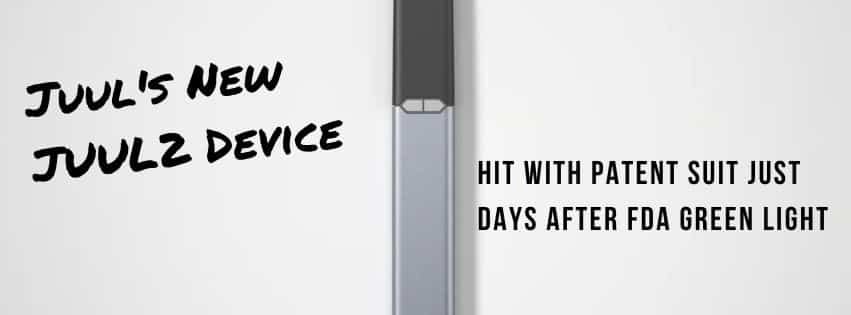
Juul’s New JUUL2 Device Hit With Patent Suit Just Days After FDA Green Light
Juul Labs finds itself back in patent court, this time facing claims that both its long-standing JUUL device and its freshly cleared JUUL2 platform infringe on intellectual property held by a small outside firm. It’s the newest chapter in what has become a nearly constant stream of IP disputes surrounding the company.
What the Complaint Says
On September 3, 2026, a Maine-based company called AJ Marketing LLC filed suit against Juul Labs in the U.S. District Court for the District of Delaware (case No. 1:26-cv-01110). The filing claims that Juul’s original device and the newer JUUL2 system both violate U.S. Patent No. 8,851,068, a patent covering “Personal Inhalation Devices.”
Unlike many patent plaintiffs that simply purchase rights from someone else, AJ Marketing holds this patent directly — it received the assignment back in 2010 from the two people who invented it, Scott A. Cohen and Michael J. Bedecs, around the time the original application was submitted. The patent was officially issued in October 2014.
The complaint describes an unusual origin story for the underlying technology: it reportedly grew out of research aimed at giving military pilots a way to receive measured doses of caffeine, intended as a safer stand-in for the stimulant drugs once used to keep flight crews awake and focused. But the patent’s actual claims aren’t limited to caffeine. They describe a broader category of device — a casing with an opening, a chamber that stores some kind of substance, and a heating component that turns that substance into vapor for inhalation. The patent text reportedly names several possible substances beyond caffeine, including nicotine, vitamins, medications, and even THC where legally permitted.
AJ Marketing argues that Juul’s vaporizing and delivery mechanism falls within those claims. The company is asking for royalty payments covering the past six years, plus continued royalties until the patent expires — a date Bloomberg Law places around January 2031. So far, Juul hasn’t filed a formal response.
The timing is notable: the lawsuit arrived just one week after the FDA cleared JUUL2, along with two matching pod flavors, through its Premarket Tobacco Product Application process. That authorization opened the door for Juul’s next-generation device to be legally sold in the U.S. — but AJ Marketing specifically named JUUL2 in its infringement allegations, meaning the product is entering the market with a lawsuit already attached.
Part of a Longer Pattern
This isn’t Juul’s first rodeo when it comes to patent fights. For roughly two years, the company has been locked in overlapping legal battles with rival Altria and its NJOY brand.
Back in August 2025, Juul asked the U.S. International Trade Commission to block imports of Altria’s NJOY Ace devices, while simultaneously pursuing a related infringement case in Delaware. At the time, Juul pointed out that the NJOY Ace was the only other pod-style device with FDA marketing clearance, and noted that it had previously won all three of its earlier ITC cases targeting counterfeit or unauthorized compatible products.
NJOY fired back with its own ITC complaint and a matching Delaware suit, alleging that Juul’s original device and pods infringed two patents NJOY had picked up from Fuma International as part of an unrelated settlement.
Separately, Juul sued both NJOY and Altria in an Arizona federal court, arguing that NJOY’s Daily product infringed a Juul patent covering nicotine salt formulations. That case produced an unexpected twist when previously sealed documents revealed that an ITC judge had already determined, in an earlier matter, that vaping products sold by R.J. Reynolds back in 2013 contained all the same elements found in Juul’s nicotine salt claims — a finding Altria and NJOY are now leaning on to argue the patent shouldn’t have been granted in the first place.
What Comes Next
The AJ Marketing case stands apart from the Altria/NJOY fights in one key way: AJ Marketing isn’t a competing vape manufacturer. It doesn’t sell any inhalation products of its own — it functions more like what’s often described as a non-practicing entity, holding a patent purely to license or litigate rather than to compete in the market directly.
Several open questions remain. Will Juul try to invalidate the patent, pointing to its 2010 priority date and broad language that predates the modern pod-vape category? Will AJ Marketing push for an injunction, or is it content to negotiate royalties, given that the complaint currently seeks damages rather than a sales ban? And perhaps most significantly, could this case set a precedent — encouraging other holders of older, broadly worded inhalation-device patents to take aim at a pod-vape market that has only grown larger and more lucrative, especially now that JUUL2 has fresh FDA backing behind it?